A Practical Guide for Stadium Operators, AV Integrators, and Media Teams
Reading time: 5 minutes
Modern sports venues are no longer just places for matches. They are media environments.
From post-match press conferences to mixed zones and live interviews, stadiums must now support a wide range of media workflows at the same time. Broadcasters, journalists, content creators, and streaming teams all expect immediate access to clean, reliable audio.
And this is where many venues still fall short.
The main challenge in sports press conferences is not capturing audio, but distributing a clean signal to multiple media devices at the same time without noise, interference, or signal loss.
Most stadiums already have high-quality sound systems in place. The difficulty begins when dozens of media representatives need access to the same signal simultaneously.
Without a structured approach, this often leads to unstable connections, inconsistent audio quality, and slow setup times. What should be a simple workflow quickly becomes a technical bottleneck.
n many venues, audio distribution is still handled through temporary splitters or improvised cabling.
That approach no longer fits the demands of modern stadiums.
Today’s venues are expected to support repeatable, professional media workflows. This is why more and more stadiums are moving toward permanent press feed points, structured audio access in mixed zones, and integration with existing AV infrastructure, including Dante networks.
Press conference audio is no longer an afterthought. It is becoming part of the core AV design.

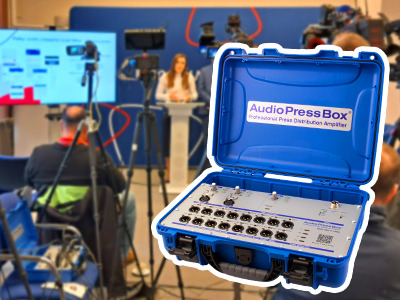
A press box, also known as a mult box, is a device that takes one audio signal and distributes it to multiple isolated outputs, allowing many users to record the same signal at the same time without loss of quality.
In a stadium environment, this ensures consistent, reliable audio for every journalist.
Media teams today use a mix of devices. Some still rely on traditional XLR inputs, while others work directly from laptops or smartphones. At the same time, many venues are already operating on networked audio systems.
This creates a hybrid environment where analog, digital, and network audio must work together seamlessly.
A modern press setup must therefore support XLR, USB-C, and Dante at the same time, without requiring additional configuration during live events.
AudioPressBox systems are designed to fit naturally into these workflows, whether installed permanently or used in portable scenarios.
For fixed installations, the APB-112 OW-D-USB provides a clean and structured solution for press rooms and media centers. It integrates with AV systems, including Dante, while also offering USB-C connectivity for journalists working with laptops and mobile devices.

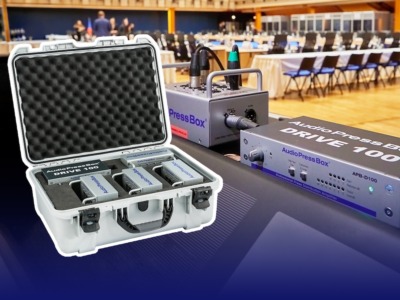
For more flexible environments such as mixed zones, the APB-320 C-D-USB offers a portable solution that combines analog and Dante inputs with multiple outputs in a single unit. Its built-in battery operation makes it ideal for fast-moving situations where speed matters.
In larger venues or during major events, the APB-1.32 CB allows the system to expand easily, supporting a higher number of media connections without compromising signal quality.

In practice, these solutions are used across several key areas.
Press conference rooms benefit from permanent installations that provide consistent performance. Mixed zones require portable systems that can be deployed immediately after the match. Media rooms and broadcast areas rely on stable, integrated audio feeds, while large-scale events require flexible expansion.
Sports environments are time-sensitive and often unpredictable. There is no room for troubleshooting when a press conference is about to begin. Broadcast schedules are tight, media presence is high, and expectations are clear.
Audio distribution must work immediately and without failure. The objective is simple: Every journalist receives the same clean audio signal, instantly.
Sports press conferences are evolving.
What was once handled with temporary solutions is now becoming a permanent part of stadium infrastructure. Reliable audio distribution is essential for delivering a professional media experience and supporting modern workflows.
This is no longer a niche requirement.
It is becoming the standard.
What is a press box (mult box) in a stadium?
A press box is an audio distribution device that splits one audio signal into multiple outputs so journalists and broadcasters can record the same clean feed at the same time.
How many journalists can connect to a press box system?
This depends on the system. Standard configurations support dozens of outputs, with the option to expand for larger events.
Can journalists use USB-C for press conference audio?
Yes. Modern systems support USB-C, allowing direct connection to smartphones, laptops, and tablets.
Is Dante useful in sports venues?
Yes. Dante enables integration with existing AV infrastructure and allows flexible routing of audio across different areas of the stadium.
Do stadiums need permanent press conference audio systems?
Yes. Permanent systems improve reliability, reduce setup time, and provide consistent media workflows.
Do not hesitate to get in touch with us. We are here to answer any questions or requests you might have.
Contact us directly at:
[email protected]