


Government Press Conferences: Reliable Audio for Public Communication
A Practical Guide for Government Institutions, AV Integrators, and Media Teams
Reading time: 5 minutes
Quick Summary
Government press conferences require systems that are not only reliable, but also accessible to a wide range of users – from traditional broadcasters to modern journalists working on smartphones and laptops.
Today’s most effective solutions combine:
- XLR outputs for professional media workflows
- USB-C connectivity for modern mobile devices
This hybrid approach ensures that every participant can access clean, stable audio without unnecessary complexity.
Why Government Environments Require a Different Approach
Unlike standard corporate events, government press conferences operate under stricter conditions, where reliability, clarity, and speed are essential. Media attendance is often high, expectations are uncompromising, and technical issues are simply not acceptable.
At the same time, the diversity of equipment used by journalists has increased significantly. Alongside traditional broadcast crews, it is now common to see reporters working entirely from smartphones or laptops, often publishing content in real time. This creates a fundamental requirement: audio systems must support both professional and consumer-level devices simultaneously, without introducing friction into the workflow.
The Role of the Press Box Remains Fundamental
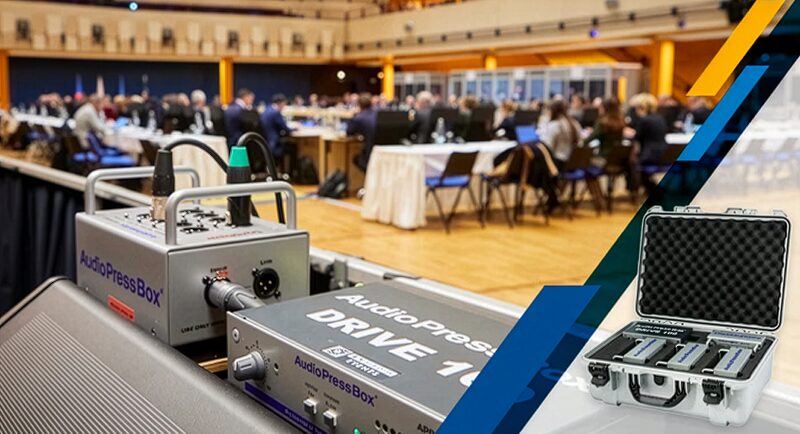
Despite changes in connectivity, the core function of a press box remains unchanged. It serves as a central distribution point, delivering clean, isolated audio from a single source to multiple users at once.
In government applications, this role becomes even more critical. Systems must ensure consistent signal quality across dozens of outputs while eliminating common issues such as noise, interference, or grounding problems. Transformer-isolated outputs, stable signal distribution, and predictable performance are therefore essential – not optional.

The Challenge: Mixed Media Workflows
Modern government press rooms are defined by diversity in both users and equipment. Professional broadcasters continue to rely on XLR connections and dedicated recording systems, while younger journalists increasingly depend on USB-C devices that lack traditional audio inputs.
Without proper infrastructure, this mismatch leads to unnecessary complications, including reliance on adapters, inconsistent compatibility, and longer setup times. In high-pressure environments such as official briefings or emergency communications, even small inefficiencies can have a direct impact on the overall reliability of the event.
USB-C as a Practical Standard for Modern Journalism
USB-C is not replacing professional audio standards, but it is becoming an essential layer that aligns press conference systems with modern user expectations. By enabling direct digital connection to smartphones and laptops, it removes the need for external interfaces and simplifies the entire workflow.
In practice, this means faster setup, fewer points of failure, and consistent audio quality. For journalists working under tight deadlines, the ability to connect instantly and start recording can be just as important as the quality of the audio itself.
Portable Solutions for Flexible Government Use
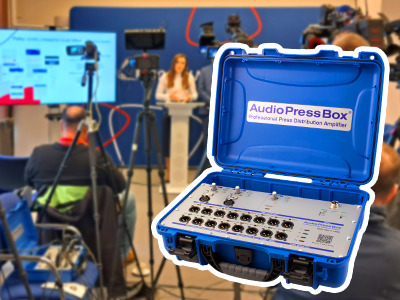
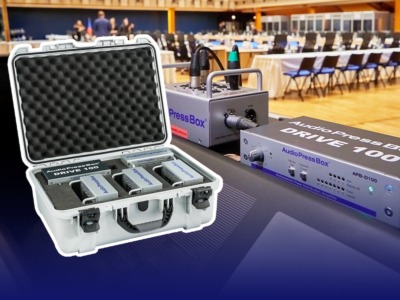
Portable press boxes play a key role in government environments where flexibility is required. They are commonly used for temporary press briefings, outdoor announcements, or field operations where a fixed installation is not available.
Devices such as the APB-312 C-USB (APB Mini) provide a compact and efficient entry point, combining analog and USB-C outputs in a portable format. For larger or more demanding events, solutions like the APB-320 C-USB extend this concept with higher channel capacity and integrated battery operation, allowing reliable deployment even in more complex scenarios.
These portable systems ensure that professional audio distribution can be achieved quickly, without compromising on quality or compatibility.

Permanent Installations in Government Facilities
In dedicated press rooms and government buildings, audio systems are typically integrated into the infrastructure itself. In these environments, in-wall and on-wall solutions provide permanent access points for journalists, eliminating the need for temporary setups.
Solutions such as the APB-112 IW-D-USB and APB-112 OW-D-USB combine USB-C connectivity with Dante networking and PoE powering, creating a clean, standardized installation that is always ready for use. This approach not only simplifies event preparation but also ensures a consistent experience across all press conferences held in the space.
Analog and USB-C: Complementary Technologies
It is important to emphasize that USB-C does not replace traditional audio outputs. Instead, it complements them by addressing the needs of modern devices while preserving compatibility with professional workflows.
XLR connections remain essential for broadcasters, cameras, and long cable runs, where reliability and signal integrity are critical. USB-C, on the other hand, provides direct and accessible connectivity for mobile devices.
The most effective systems are therefore those that combine both approaches, ensuring that no user group is excluded.
Beyond Press Conferences: Broader Government Applications
While press conferences are the most visible use case, press box systems are widely used across a range of government applications. These include parliamentary sessions, public hearings, courtrooms, and live-streamed official events.
In all of these scenarios, the requirements remain consistent: clear audio distribution, reliable performance, and easy access for multiple users. As hybrid and digital communication continues to grow, the importance of flexible, well-designed audio infrastructure becomes even more significant.
What This Means in Practice
For AV designers, system integrators, and government institutions, expectations are clearly shifting. Systems that rely solely on traditional connectivity introduce unnecessary complexity, while those that lack professional outputs fail to meet broadcast requirements.
Hybrid solutions provide a balanced approach, delivering both reliability and accessibility. In practical terms, this results in faster setup, improved compatibility, and more predictable operation across all types of events.
Conclusion: Built for Public Communication
Government communication requires systems that perform flawlessly under pressure while remaining accessible to all users. The evolution toward hybrid press box solutions reflects this reality, combining proven audio reliability with modern connectivity standards.
By integrating XLR and USB-C into a single system, it becomes possible to support both traditional media and new digital workflows without compromise.
Final Takeaway
The future of government press conference audio lies in hybrid solutions that combine:
- XLR for reliability and professional workflows
- USB-C for accessibility and modern devices
- Flexible deployment across portable and fixed installations
This approach ensures that every journalist – regardless of equipment – can access high-quality audio in any environment.
Frequently Asked Questions (FAQ)
Can government press rooms support both professional and mobile journalists?
Yes. Hybrid systems combining XLR and USB-C allow both groups to connect easily and reliably.
Why is USB-C important in government press conferences?
Because many journalists now use smartphones and laptops without traditional audio inputs, USB-C enables direct and simple connectivity.
Are portable press boxes suitable for government use?
Yes. They are widely used for temporary briefings, outdoor events, and field operations where flexibility is required.
What is the advantage of fixed installations?
They provide a permanent, clean, and ready-to-use solution with consistent access to audio for every event.
Do broadcasters still rely on XLR connections?
Yes. XLR remains the standard for professional audio workflows and is essential for broadcast applications.
News








Contact us
Do not hesitate to get in touch with us. We are here to answer any questions or requests you might have.
Contact us directly at:
[email protected]