A Practical Guide for Journalists, AV Teams, and Event Organizers Reading time: 5 minutes
USB-C is quickly becoming the default interface for journalists at press conferences, not because it replaces existing audio standards, but because it reflects how media professionals actually work today. Instead of relying on adapters and external interfaces, modern workflows favor direct, digital connectivity.
Modern press conference systems are therefore evolving toward hybrid solutions that combine:
This approach ensures compatibility, reliability, and long-term flexibility.

The shift toward USB-C is not driven by the AV industry itself, but by the devices journalists bring into the room. Laptops, smartphones, and tablets increasingly rely on USB-C as their primary or only interface, while traditional audio inputs such as 3.5 mm jacks are disappearing.
This creates a growing disconnect between professional audio infrastructure and end-user equipment.
In practical terms, this means that even though press conference systems continue to deliver high-quality, balanced audio, many users are no longer able to access that signal without additional hardware. USB-C resolves this mismatch by providing a universal digital interface aligned with modern devices.
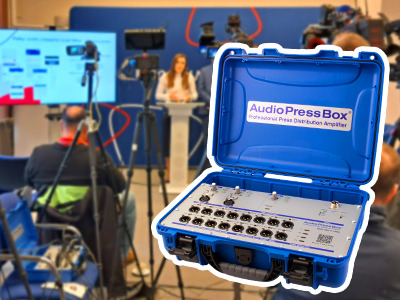
A press box (audio mult box) still performs one essential function: distributing clean and reliable audio from a single source to multiple users simultaneously.
Traditional systems – such as the APB-224 C – remain the benchmark due to:
These fundamentals are not changing. What is changing is how users connect.

Modern press conferences face a simple but critical issue:
Journalists arrive with USB-C devices, not audio equipment.
This leads to recurring problems:
In high-pressure environments, this friction directly impacts reliability.
Integrating USB-C into press conference systems simplifies access without changing the core audio workflow. By enabling direct digital connection, it removes common issues associated with analog setups, such as noise, signal loss, and grounding problems.
At the same time, it aligns with current media practices, where recording, editing, and publishing often happen on a single device within minutes.
In practical terms, USB-C enables:
The shift toward USB-C is already reflected in modern press box design, covering both portable and installed environments.
Portable Entry-Level Solution
The APB Mini (APB-312 C-USB) is designed for smaller press conferences and mobile setups. It provides a compact and practical way to introduce USB-C connectivity while maintaining professional audio distribution. Its combination of analog and USB-C outputs makes it ideal for quick deployment where simplicity and reliability are key.

For more demanding environments, the APB-320 C-USB extends this concept into a fully hybrid solution. With higher channel capacity, USB-C integration, and built-in battery operation, it is suited for large-scale press conferences and hybrid events where both traditional broadcasters and modern digital media are present.
In fixed press rooms, USB-C becomes part of the infrastructure rather than an add-on.
In-wall and on-wall solutions, such as:
provide direct USB-C access points for journalists, combined with Dante networking and PoE powering. This results in a clean, standardized installation without the need for temporary setups.
These systems are typically used in:


USB-C does not replace traditional audio outputs. Instead, it complements them.
Analog XLR connections remain essential for:
USB-C, on the other hand, addresses accessibility for modern devices.
The most effective systems combine:
This hybrid approach ensures compatibility across all user groups.
The importance of USB-C is closely tied to the rise of hybrid events. Press conferences are no longer limited to physical spaces; they are streamed, recorded, and distributed in real time.
USB-C simplifies this process by enabling direct integration with:
This reduces complexity and supports faster, more efficient workflows.
For AV designers and event organizers, expectations are shifting.
Systems without USB-C require workarounds. Systems with native USB-C support provide:
This is no longer a premium feature – it is becoming a baseline requirement.
USB-C is becoming a standard at press conferences not because it introduces new capabilities, but because it reflects how media professionals already work. It simplifies workflows, reduces technical barriers, and connects professional AV systems with everyday devices.
The future lies in hybrid solutions that combine:

USB-C is becoming the standard interface for press conference audio access.
Systems that combine:
are best positioned to meet current and future demands.
AudioPressBox USB-C solutions are designed exactly for this transition – from portable setups to fully integrated press environments.
Can you use USB-C to record audio at a press conference?
Yes. USB-C allows direct connection from a press box to smartphones, laptops, or tablets without external interfaces.
How do journalists connect using USB-C?
They simply connect via a USB-C cable, and the device recognizes the press box as an audio input.
Do you still need XLR outputs?
Yes. XLR remains essential for broadcasters and professional equipment. USB-C complements it.
What is the advantage of USB-C?
It provides digital audio, eliminates noise issues, and simplifies setup.
Can smartphones record professional audio?
Yes. USB-C enables direct, high-quality digital audio recording.
Is USB-C important for hybrid events?
Yes. It allows direct integration with streaming and conferencing platforms.
Do not hesitate to get in touch with us. We are here to answer any questions or requests you might have.
Contact us directly at:
[email protected]